
Sodium Bentonite Grinding Mill 15 t/h
Why a 15 t/h Bentonite Grinding Line to 85–95 Mesh?
Sodium bentonite is one of the most versatile industrial clays in the world. Because of its high montmorillonite content, it can swell up to 15–20 times its dry volume and absorb more than 60% of its own weight in water — properties that make it indispensable in drilling mud, foundry sand, iron-ore pelletizing, cat litter, civil engineering and agricultural soil conditioning.
For most of these uses, the raw lump cannot be consumed directly. A bentonite grinding mill is required to convert coarse ore into a controlled, uniform powder. When your production target is 15 tons per hour of 85–95 mesh sodium bentonite powder from 40 mm feed lumps, the equipment and process layout must be engineered as one integrated system — not as a collection of independent machines.
In this guide, the Baichy Heavy Industry team walks through the complete solution: the process flow, the recommended mill configuration, the key parameters you should verify before purchasing, and the operating considerations that determine uptime and product quality.
What "85–95 Mesh" Actually Means
Mesh describes how fine a powder is by how many openings per inch a screen has. An 85-mesh screen has 85 openings per inch (approximately 180 µm), while 95 mesh is finer (approximately 150 µm). So 85–95 mesh bentonite powder is a mid-coarse, highly uniform grade sitting between coarse sand-like material and standard fine powder (which typically runs 200–325 mesh).
This range is deliberately chosen for applications where fast hydration and controlled swell matter more than ultra-fine surface area — feed additives, soil amendments, low-end drilling additives, and blending base materials. A bentonite powder making machine set to 85–95 mesh gives you the balance of cost efficiency and functional performance.
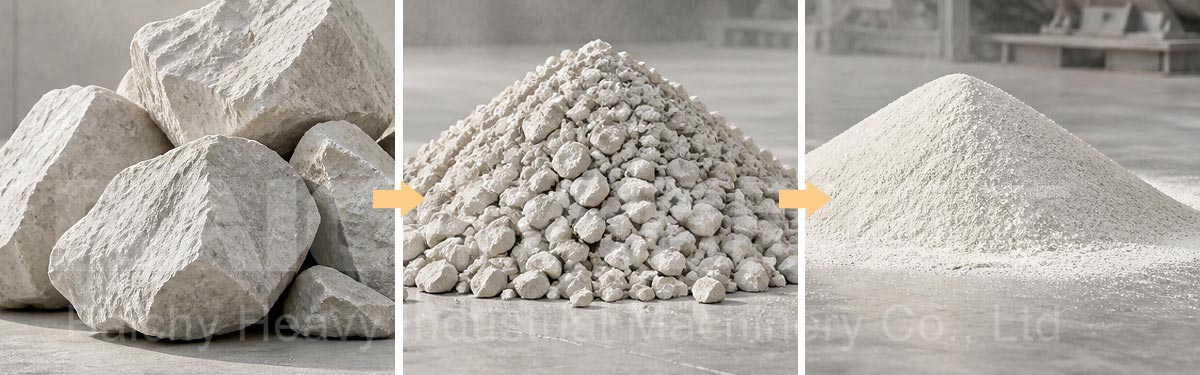
Milled bentonite product
Why Sodium Bentonite Specifically?
Sodium bentonite (Na-bentonite) differs from calcium bentonite in its exchangeable cation. It swells far more aggressively in water and forms thixotropic gels, making it the preferred base for high-performance drilling fluids, clumping cat litter, and foundry mold binding. When you grind sodium bentonite, you must control fineness and moisture carefully — over-grinding raises cost without improving performance, while under-grinding leaves oversized particles that hurt hydration uniformity.
The Process Flow — From 40 mm Lumps to Finished Powder
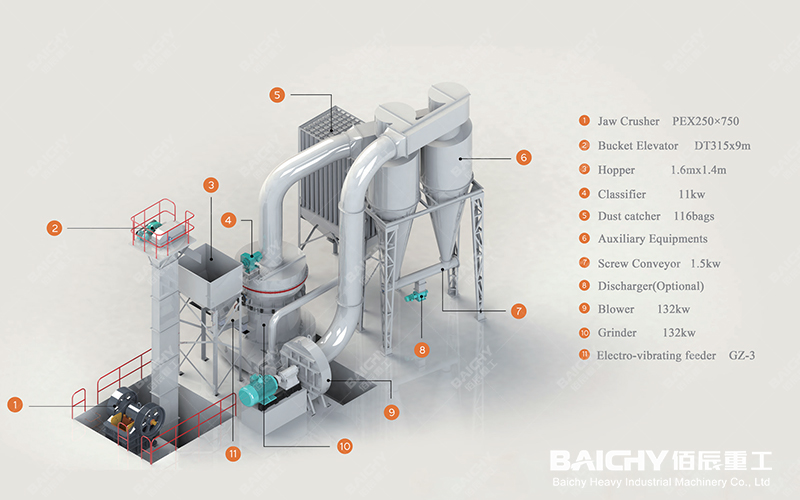
Bentonite Grinding Process Flowchart
A well-designed 15 t/h bentonite grinding line follows a clean, closed-loop flow. Because the feed is already reduced to 40 mm lumps, no heavy primary crusher is needed — the material can be fed directly into the mill, saving capital and floor space.
Step 1 — Feeding and Pre-Conditioning
Raw sodium bentonite lumps (≤ 40 mm) are metered into the system by a vibrating feeder. Accurate, even feeding is critical: it protects the grinding chamber from overload, stabilizes power draw, and keeps fineness consistent. If the raw ore carries high surface moisture (bentonite often arrives at 15–35% moisture from the mine), a rotary dryer or hot-air assist in the mill is recommended to bring moisture below 6–8% before grinding. Moisture is the single biggest threat to grinding stability for this material.
Step 2 — Grinding in the Bentonite Mill
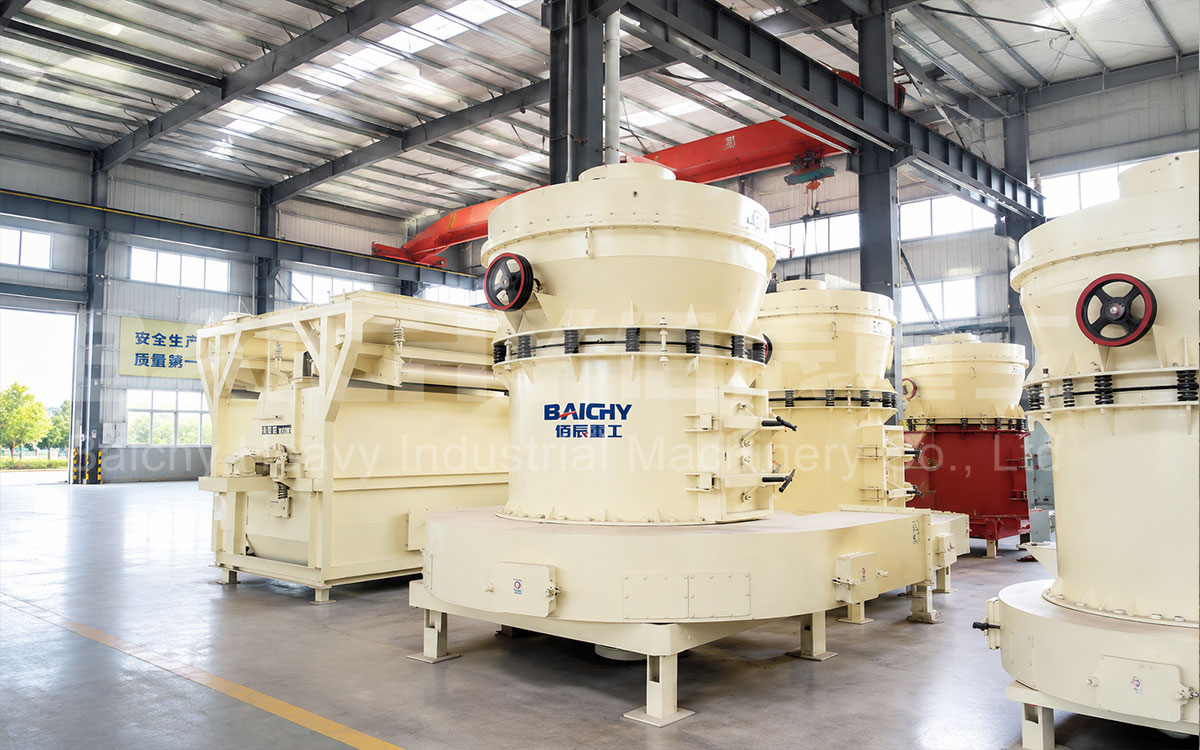
The heart of the line is the bentonite grinding mill — a pendulum (Raymond-type) roller mill configured for this duty. A large-model pendulum mill comfortably delivers 15 t/h at 85–95 mesh while grinding between a stationary grinding ring and rotating rollers, using centrifugal force to crush and grind the material layer by layer.
Step 3 — Classification and Collection
Inside the mill, an integrated air classifier returns oversized particles to the grinding zone and sends on-spec powder to the collecting circuit. A cyclone and pulse-jet bag filter capture the finished 85–95 mesh bentonite powder, while clean air is discharged. The entire circuit is negative-pressure and low-dust, which improves both workplace safety and compliance with emission limits.
Core Equipment — Baichy Bentonite Grinding Mill Configuration
For a 15 t/h duty at 85–95 mesh, Baichy recommends a high-capacity pendulum mill as the core of the line, matched with the auxiliary equipment below. The following table summarizes the key parameters of the recommended configuration:
| Parameter | Value / Range | Notes |
|---|---|---|
| Feed Material | Sodium bentonite lumps (Na-montmorillonite) | Mohs hardness ≤7 |
| Feed Size | ≤40 mm | Direct mill feed, no primary crusher needed |
| Product Fineness | 85–95 mesh (≈180–150 µm) | Adjustable via integrated air classifier |
| Processing Capacity | 15 t/h (steady state) | Confirmed against raw moisture ≤6–8% |
| Recommended Mill | High-capacity pendulum / Raymond-type mill | Model sized by Baichy after material test |
| Main Motor Power | 110–185 kW (model-dependent) | Matched to 15 t/h at this fineness |
| Auxiliary Equipment | Vibrating feeder, cyclone, pulse-jet bag filter, blower, control panel | Closed-loop, negative-pressure circuit |
| Inlet Moisture Limit | ≤6–8% (drying recommended above this) | Optional rotary dryer / hot-air assist |
| Final Product Moisture | ≤2–5% | Suited to packing and storage |
| Operation Mode | Fully automated, PLC control | One-operator supervision typical |
How to Choose the Right Model for 15 t/h
The correct mill model is a function of three variables: required throughput (15 t/h), target fineness (85–95 mesh), and raw-material hardness and moisture. Because these interact, Baichy always recommends a lab grindability test on your actual ore before final selection. A mill that delivers 15 t/h at 200 mesh may behave differently at 85–95 mesh — and vice versa. Selecting on paper data alone is the most common reason lines underperform.
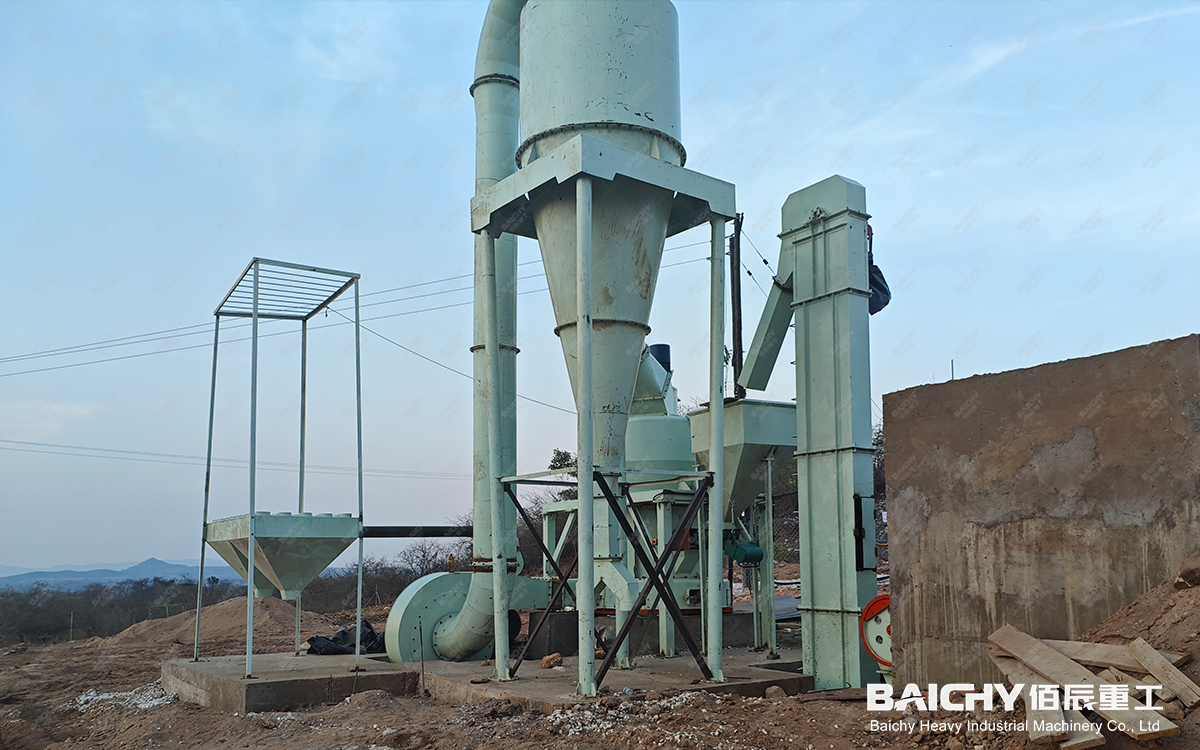
Milling site in Tanzania
Engineering Considerations That Protect Your Investment
Moisture Control Is Non-Negotiable
Bentonite is hygroscopic. If feed moisture exceeds the mill's design limit, material sticks to the ring and rollers, capacity collapses, and finished powder cakes in pipes and filters. Planning a dryer — or confirming hot-air grinding capacity — at the design stage is far cheaper than retrofitting it after startup.
Abrasion and Wear Parts
Although bentonite is soft (below Mohs 7), quartz and sand inclusions can accelerate wear on grinding rollers, rings, and the classifier. Choosing wear-resistant alloy materials and keeping spare parts in stock minimizes downtime. Expect regular inspection of the grinding elements as part of your preventive-maintenance schedule.
Dust Collection and Safety
Bentonite powder is fine and can carry dust. A correctly sized pulse-jet bag filter keeps emissions compliant, protects operators, and recovers saleable product instead of losing it to the atmosphere. A fully automated control system also protects the mill from overload and ensures consistent output.
Applications of 85–95 Mesh Sodium Bentonite Powder
The 85–95 mesh grade serves a wide range of downstream industries:
- Drilling fluids: a cost-effective base for water-based mud systems, providing viscosity, cuttings suspension, and borehole sealing.
- Foundry sand bonding: the binder in green-sand molding, where uniform particle size gives consistent mold strength.
- Cat litter and pet products: clumping grades rely on sodium bentonite powder with reliable hydration behavior.
- Civil engineering: sealing layers, slurry walls, and waterproofing where controlled swelling is required.
- Agriculture and feed: soil conditioning and feed-binding additives that benefit from a stable, dust-controlled powder.
In each case, consistent fineness and low moisture are what make the difference between a reliable product and a rejected batch. A well-tuned bentonite grinding mill is what guarantees that consistency hour after hour.
Economics — Why This Line Pays Back
At 15 t/h and roughly 8,000 operating hours per year, a single line can produce around 120,000 tons of 85–95 mesh bentonite powder annually. Pendulum mills are recognized for low specific energy consumption — Baichy's design aims for 30–40% electricity savings versus conventional ball mills at the same duty. Lower energy, lower wear-part cost, and a compact footprint combine to deliver a short payback period and strong margin per ton, especially when you also capture by-product and minimize dust loss.
Why Choose Baichy Heavy Industry?
Baichy Heavy Industry is a professional manufacturer of mining crushing, ore grinding, and mineral processing equipment. We do not simply supply a machine — we engineer the process:
- Application-matched design based on testing your actual ore.
- Turnkey line supply — feeder, mill, classifier, dust collection, and control in one package.
- Verified performance — every configuration is sized to your stated 15 t/h and 85–95 mesh targets.
- Global service — installation guidance, commissioning support, training, and reliable spare-part supply.
FAQ
1. Can the mill grind 40 mm bentonite lumps directly?
Yes. The recommended pendulum mill accepts feed up to roughly 40 mm without a primary crusher, which saves capital and simplifies the plant.
2. What moisture content should the feed have?
Keep inlet moisture at 6–8% or below. Higher-moisture ore should be dried first to protect grinding stability and throughput.
3. Can the fineness be changed after purchase?
Yes. The air classifier is adjustable, typically within the 80–325 mesh range, so the same mill can produce different grades as market demand shifts.
4. How do I confirm the line will really make 15 t/h?
Provide a sample of your bentonite for a grindability test. Baichy then confirms model selection, power, and auxiliary sizing against your actual material.
Baichy Heavy Industry
Baichy Heavy Industry is a high-tech mining equipment company integrating R&D, manufacturing, sales, and after-sales service. Focusing on crushing, grinding, and mineral processing equipment, we provide professional solutions to our customers. We are ISO9001:2015 、certified, and our products include mobile crushing palnts, crawler crushing plant, construction waste crushing plants, jaw crushers, sand making machines, cone crushers, fine crushers, grinding mills, ball mills, etc., all with reliable performance to meet diverse project needs.
Baichy Heavy Industry – Your Trusted Partner
To ensure optimal performance of your equipment, Baichy Heavy Industry offers:
- Professional on-site installation guidance
- Comprehensive operator training
- 24/7 technical support & maintenance services
Our complete after-sales service system guarantees long-term, stable operation of your machinery with minimal downtime.
Protect Your Rights – Only Use Official Channels
To avoid scams and ensure authentic support, contact us exclusively through:
• Official Website: www.baichychina.com
• WhatsApp: +8615093222637
• Email: [email protected]
Your satisfaction is our priority – expect prompt, professional service every time.
(Note: Beware of unauthorized third parties claiming to represent Baichy. Always verify through official contacts.)